
Haifa MKP TECH

Consists of:
Potassium (K) total – 28,7%, Potassium Oxide (K2O) – 34%, Phosporus (P) Total – 22,7%, Phosphorus pentoxide (P2O5) – 52%.
Haifa-MKP TECH™ Mono Potassium Phosphate (0-52-34) is a fully water-soluble mono-potassium phosphate fertilizer, a highly efficient source of phosphorus and potassium for plants.
Haifa MKP is a nitrogen-free fertilizer, and is the preferred source of phosphorus and potassium when nitrogen fertilization should be limited. Early in the growing season, when phosphorus and potassium are needed are high rates for establishment of root system for example. Using Haifa MKP at the productive stages of sugar-rich fruit crops helps to increase sugar content and to improve the quality.
Haifa MKP can be applied in combination with other fertilizers to meet crop nutritional needs throughout the growth cycle. Additionally, Haifa MKP is suitable for preparation of fertilizer blends and production of liquid fertilizers.
Haifa MKP Mono Potassium Phosphate Fertilizer for hydroponic or greenhouse farms is preferred since it’s highly water soluble, and it’s great for foliar application and it’s used to help boost Potassium and Phosphorus during the flower and vegetative periods. This is the secret ingredient to many pk boosters sold.
TIP: Haifa MKP should not be mixed with calcium or magnesium fertilizers.
The advantages of Haifa MKP
- Fully water-soluble
- Consists of 100% plant nutrients
- Free of chloride, sodium and other detrimental elements for plants
- Safe for plants and humans: has a moderately low pH and low salt index
- Suitable for the Nutrigation, foliar application and production of fertilizer blends and nutrient solutions.
Uses:
Nutrigation:
Haifa MKP is recommended to use as a source of phosphorus and potassium where nitrogen levels should be kept low. Haifa MKP has unique characteristics, it can be applied through any irrigation system and on any growing medium. Unlike phosphoric acid for example. Haifa MKP is moderately acidic, therefore it does not form corrosion on fertilizer pumps or irrigation equipment.
Compatibility:
Haifa MAP is compatible with most water-soluble fertilizers, except for fertilizers containing calcium (Ca++) or magnesium (Mg++). In order to apply Haifa MAP fertilizer in combination with calcium or magnesium fertilizers, please use two fertilizer tanks. If the system has only one tank, apply these fertilizers at different times.
Quantitative Nutrigation:
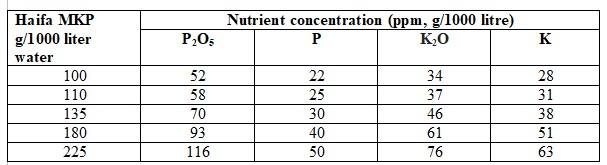
Each kilogram of Haifa MKP in the tank consist of 520 grams of Phosphorus oxide (P2O5) (230 grams P) and 340 grams of Potassium Oxide (K2O) (280 grams K).
Proportional Nutrigation:
The phosphorus and potassium concentration in the irrigation water depends on the quantity of Haifa MKP Fertilizer in the tank mix, and on the injection ratio. Use the following table to calculate the quantity of Haifa MKP and the injection ratio needed to reach your target concentration in the irrigation water.
Foliar Nutrition:
Haifa MKP is suitable for foliar spraying. It is effective in supplying phosphorus and potassium whenever quick response to deficient plants is required. Early season foliar application with Haifa MKP encourages the establishment of healthy root system.
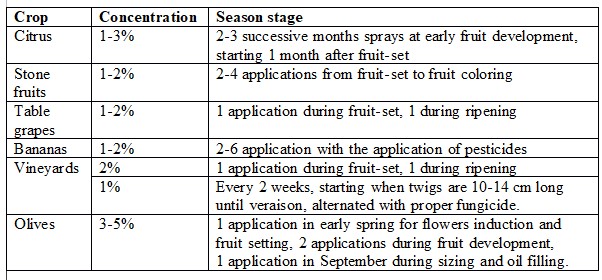
Haifa MKP is an efficient suppressor of powdery mildew in susceptible crops (deciduous, cucumber, melons, vineyards, roses and others) When applying 1.0% Haifa MKP mixed with systemic fungicides improves the efficiency and enable to reduce application rates of the latter.
Haifa MKP is compatible with most commonly used pesticides and fertilizers. However, mixing with Calcium and Magnesium should be avoided. Iron, manganese, zinc and copper must be in the form of chelates.
Field-crops and vegetables:
On young leaves, spray a concentration of 1.0% Haifa MKP is recommended in most crops. On mature leaves and more tolerant crops, concentration of 2.0% may be applied.
Fruit trees:
TIP: It is advisable to confirm compatibility of your intended spray-mix by preparing a sample of the mixtures at their recommended concentrations in order to rule out the possibility of a detrimental cross reaction. The mixtures should be sprayed onto a small area to test before using it fully. You do this to test whether an adverse effect occurs when foliar spraying your mixture.